

Paraben-free and sulfate-free: what the labels mean
Paraben-free means the product contains none of the paraben family of preservatives, and sulfate-free means it contains none of the sulfate family of foaming cleansers. That is the whole paraben free sulfate free meaning: two statements about what was left out. Bale is both. What the words do not tell you is what went in, and that is the part worth reading on any label.
What are parabens, and what does paraben-free mean?
Parabens are a group of preservatives that have been used in cosmetics for a long time. Their job is to stop mold, yeast and bacteria growing in a product, which matters most in anything that contains water, because water is what those things need to grow. You will see them on ingredient lists under names ending in paraben: methylparaben, propylparaben and so on.
Paraben-free means none of that group is in the formula. It does not mean the product has no preservative at all; it may use a different one, or it may be a formula with little or no water in it, which needs less protecting in the first place. A body butter made on shea and cocoa butter is mostly butters and oils rather than water, which is one reason the question comes up less for a butter than for a lotion.
People hold opinions about parabens on both sides. We are not going to make a health claim either way. The label states what is in the jar, and you decide what you make of it.
What are sulfates, and what does sulfate-free mean?
Sulfates are detergents. The common ones, sodium lauryl sulfate and sodium laureth sulfate, are what make a shampoo, body wash or toothpaste foam up and lift oil off skin and hair. They are good at that job, which is also why some men with dry skin find a sulfate body wash leaves them tight and itchy after a shower.
Sulfate-free means none of those detergents is in the formula. For a wash, that is a meaningful choice that changes how it feels. For a leave-on body butter, it is close to a given: a butter is meant to stay on your skin and put oil back, so there is no reason for a foaming cleanser to be anywhere near it. We print it because it is true and because it is a common question, but the sulfate decision that matters is really the one about your body wash, and the wash, butter, cologne order article covers where it fits.
So what is the paraben free sulfate free meaning in practice?
Two things were left out. That is useful, but it is a short list, and a label that leads with what is missing is sometimes hoping you will not ask what is present. The better questions for a body butter are these:
- What is the base? Bale's is shea and cocoa butter, which is where the softness and the long wear come from.
- What makes it smell? Fragrance. Each of the six Bale scents is our take on the profile of a designer bottle, and the fragrance label article explains what that one word on a label covers.
- What else is in there? For Bale, a pheromone ingredient. The full ingredient list is coming soon, and until it is published the honest description is this: a shea and cocoa butter base, fragrance and a pheromone ingredient.
- Does it do what you bought it for? One scoop on damp skin absorbs in about a minute with no shine and lasts 12+ hours on most skin. No free-of claim tells you that; wearing it does.
Does free-of mean natural, gentle or safe?
No, and the words are not interchangeable. "Natural" has no fixed meaning on a cosmetics label, and a formula can be free of parabens and sulfates and still disagree with your skin, because scented products of any kind can bother sensitive skin. If yours is reactive, patch test any scented product on the inside of your forearm before you wear it properly, free-of label or not. Bale is a scented body butter rather than medical skincare, and if you have a skin condition, ask your doctor.
What the two claims do tell you is that the maker made two specific choices and was willing to put them in writing. Treat them as a starting point for reading the rest of the label, and be wary of any label that uses them as the whole pitch.
Why does Bale put these two on the jar?
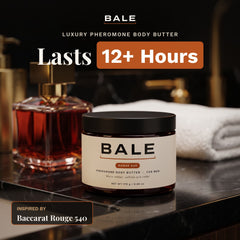
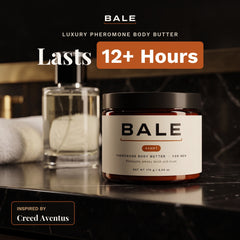
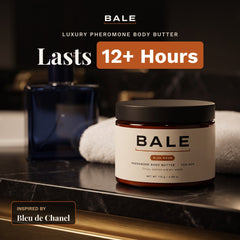
Because they are true, and because it is a common question. The rest of the jar is deliberately plain: amber glass, black lid, cream label, the scent name and the two claims. The story is on the outside of the parcel, in the piece of a real coffee sack every order is wrapped in, with a card that says where in the world it came from. Which is the right way round, I think: the label tells you what is in it, the sack tells you who made it.
Quick answers
What does paraben-free mean?
The product contains none of the paraben family of preservatives, the ingredients whose names end in paraben. It may use a different preservative, or be a low-water formula that needs less of one. It says nothing about what else is in it.
What does sulfate-free mean?
None of the sulfate detergents, such as sodium lauryl sulfate, is in the formula. Those are the foaming cleansers in shampoo and body wash. A leave-on body butter has no use for them, so for a butter the claim is easy to meet.
Is paraben-free the same thing as natural?
No. Natural has no fixed meaning on a cosmetics label, and a product can be free of both and still contain plenty of made ingredients, including fragrance. Read the full ingredient list rather than the free-of claims.
Is Bale paraben-free and sulfate-free?
Yes, both. The base is shea and cocoa butter, scented with fragrance. The full ingredient list is coming soon.
If you want to know what the jar does rather than what it leaves out, the Discovery Set week plan is the way to find out on your own skin, and the 6 oz jar article covers how to use it once you have picked. The FAQ has the short version of what is inside.


